
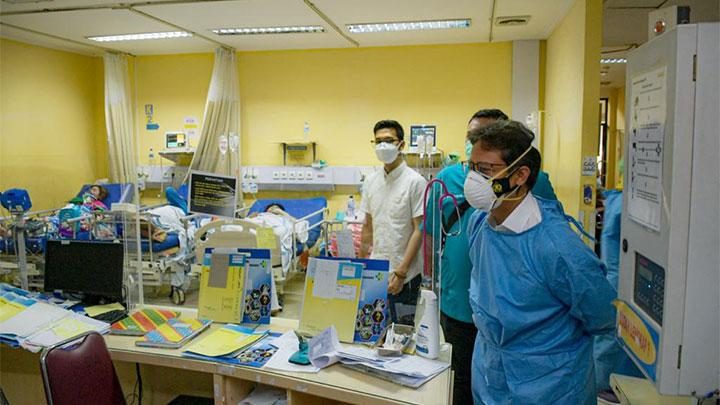
When a health minister publicly states that a country is pivoting to 'more advanced treatment' because conventional Covid drugs are unavailable, the market tends to read that as a domestic logistics footnote. It is not. Indonesia, with a population of 278 million and the largest economy in Southeast Asia, has just broadcast something far more consequential: the global antiviral supply chain that was stress-tested during the 2021 to 2023 pandemic cycle has not been rebuilt to a durable standard. The shortfall hitting Indonesian hospitals now is a real-time indicator of a structural problem that runs from raw material sourcing in China and India, through WHO procurement frameworks, all the way to the royalty and licensing arrangements that determine who manufactures what and at what scale. Every link in that chain has a publicly traded proxy, and most of them are mispriced right now.
The Supply Chain Architecture Nobody Fixed After 2023
The antiviral drugs most relevant to Covid management, primarily nirmatrelvir-ritonavir combinations and molnupiravir, were never restructured for sustained emerging market distribution after emergency use authorizations expired. The Medicines Patent Pool had brokered generic licensing agreements covering 95 low and middle-income countries, but manufacturing ramp-downs that began in late 2023 as wealthy-nation demand collapsed were never reversed for the tier of countries that still carry meaningful Covid burden. Indonesia sits in a structural gap: too wealthy to qualify for the deepest concessionary pricing, too price-sensitive to absorb innovator-brand costs at scale. The result is formulaic shortages that will repeat. What makes this macro-relevant is scale. ASEAN's combined pharmaceutical import bill runs above $22 billion annually, and any policy shift toward regional self-sufficiency, already being discussed in Jakarta and Hanoi, redirects capital allocation across the entire sector.
The second-order read is on Indian and Chinese API manufacturers. Active pharmaceutical ingredient supply for antivirals is heavily concentrated, with India accounting for approximately 20 percent of global generic drug exports by value. A sustained Southeast Asian policy push toward regional stockpiling, the logical political response to a minister admitting a shortage on the record, would require procurement contracts that currently do not exist. That is a revenue line that Divi's Laboratories, Sun Pharma, and their peers are not pricing into forward guidance. The spread between where those stocks trade and where a regional stockpile mandate would push their order books is a gap that resolves over 12 to 24 months, not quarters.
A health minister conceding a drug shortage on the record is not a domestic logistics story. It is a live audit of every assumption the market made about pandemic preparedness spending between 2020 and 2023, and the verdict is that the rebuild was incomplete.
What 'Advanced Treatment' Actually Signals for Biotech Capital Flows
The minister's phrase 'more advanced treatment' is doing significant work. It almost certainly refers to a shift toward monoclonal antibody therapies or hospital-administered antivirals rather than outpatient oral regimens. That is not a semantic distinction. It is a cost and infrastructure multiplier. Outpatient oral antivirals cost Indonesia's health system roughly $20 to $50 per treatment course under generic licensing. Monoclonal antibody protocols run $500 to $2,000 per patient even at concessionary rates, require cold chain logistics, and demand trained clinical administration. A forced pivot to advanced inpatient-equivalent treatment, applied across a population of 278 million with a healthcare spend of approximately 3.7 percent of GDP, creates fiscal pressure that cascades into sovereign bond spreads, rupiah volatility, and ultimately into JKSE sector weightings. Healthcare as a share of Indonesia's equity index is under 4 percent, which means the repricing happens in currency and rates markets before equity investors feel it.
For global biotech specifically, this creates a bifurcated capital flow dynamic. Large-cap Western originators like Pfizer and Merck face pricing pressure and volume uncertainty simultaneously: emerging markets cannot afford list prices, and their generics revenue has collapsed with pandemic-era emergency contracts. Meanwhile, biotech firms with platform technologies capable of rapid, low-cost antiviral synthesis are getting a live proof-of-concept argument handed to them. mRNA platform companies and synthetic biology firms working on broad-spectrum antivirals have a geopolitical tailwind that was not legible before Jakarta's minister spoke. The risk capital that was rotating out of pandemic-adjacent biotech in 2024 may find a re-entry signal here.
The Emerging Market Sovereign Dimension Most Analysts Are Skipping
Indonesia's fiscal position is tighter than the headline deficit number suggests. The government's debt-to-GDP ratio sits near 39 percent, which looks conservative in isolation, but off-balance-sheet healthcare liabilities through the Jaminan Kesehatan Nasional, the national health insurance scheme covering over 260 million enrollees, represent contingent fiscal exposure that ratings agencies have not fully captured. A structural shift in treatment protocols toward high-cost advanced therapies does not stay inside the health ministry's budget line for long. It pressures Jaminan Kesehatan Nasional reimbursement schedules, which then create arrears with hospital networks, which then stress regional banking credit quality. This is the third-order chain that connects a drug shortage headline to, counterintuitively, Indonesian regional bank non-performing loan ratios in 2025 and 2026.
The broader emerging market read amplifies this. Indonesia is not the only Southeast Asian nation running this structural gap. Vietnam, the Philippines, and Bangladesh face similar antiviral access constraints. A coordinated policy response, which ASEAN health ministers have discussed in principle but not funded in practice, would require multilateral procurement mechanisms. That pulls the World Bank's pandemic preparedness lending facilities and the Asian Development Bank's health infrastructure windows into active deployment. Both institutions' bond issuances would increase as a result, adding to regional hard-currency sovereign supply at exactly the moment when the Fed's rate path keeps dollar funding costs elevated. The pressure point is real and the timeline is measured in months.
How Zentra Positions Around Healthcare Supply Shocks
At Zentra, the instinct when a healthcare supply shock surfaces is not to chase the obvious long in whoever manufactures the scarce drug. That trade is crowded within 48 hours and the options skew reprices immediately. The more durable edge lives in the volatility surface. When a structural supply gap gets confirmed by a government minister, realized volatility in the affected sector tends to lag implied volatility by roughly two to three weeks as the market processes second-order effects. That lag creates a specific opportunity in delta-neutral structures: selling near-term implied volatility in large-cap pharma names that have already repriced directionally, while buying longer-dated volatility in the biotech and API manufacturer universe where the structural shift has not yet been priced.
The practical expression right now is a ratio spread structure on the iShares Biotechnology ETF against a short gamma position in a basket of large-cap originator pharma. The thesis is straightforward: the originator names have absorbed the headline risk and their vol surfaces reflect it; the biotech and generics manufacturers have not yet priced the multi-year procurement tailwind. Delta-neutral means the position does not need a directional call on whether pharma rallies or sells off. It needs the volatility differential between those two universes to converge, which supply chain news of this nature historically drives over a 60 to 90 day window. The Indonesia story is the kind of event that generates precisely that divergence.
This is how we position at Zentra Asset Management
Delta-neutral strategies that profit from volatility, not direction. See our full track record and research library.
Access Zentra Asset Management →The forward picture is one of accelerating policy divergence across Southeast Asia. Nations that can afford to will accelerate domestic manufacturing incentives, pulling API contract flows away from the current concentration in Indian and Chinese suppliers. Nations that cannot afford to will lean harder on multilateral health financing, adding to ADB and World Bank bond supply. Both paths create identifiable volatility events across currency, rates, and equity vol surfaces over the next two to four quarters. The Indonesia drug shortage is not a human interest footnote to a pandemic that markets have moved on from. It is an early signal that the structural underinvestment in non-Western antiviral supply chains is about to become a recurring and increasingly market-legible risk. The vol surface in biotech and the credit spreads in Southeast Asian sovereign debt are not yet reflecting that probability. They will.