
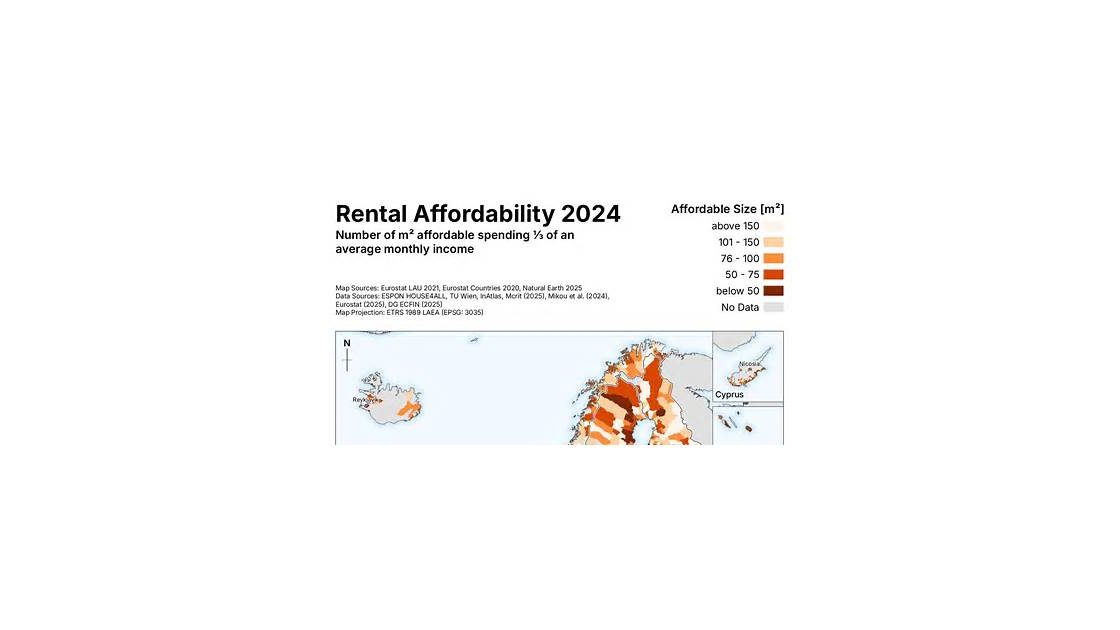
When researchers compile more than 22 million property listings across Europe and conclude that housing affordability has reached crisis levels, the instinct is to frame it as a social problem. A government failure, perhaps. A planning debate. That framing costs you money. What the data actually describes is a structural consumption headwind embedded into the balance sheets of European households, a slow-motion drag on discretionary spending that compounds every quarter ECB rates stay elevated. The second-order effects are not showing up in equity analyst models, and they are certainly not showing up in European sovereign spread pricing. That gap between what the data is saying and what markets are pricing is exactly where macro research earns its keep. This piece traces the chain from overpriced square footage all the way to specific asset classes that need to reprice.
The Scale of the Problem Is Not What You Think
The 22 million listing study is not measuring a shortage of housing supply in a few gateway cities. It is documenting a continent-wide affordability collapse that spans northern, southern, and central Europe simultaneously. In Germany, the country that spent a decade congratulating itself on rental market stability, asking rents in major cities rose more than 60 percent between 2015 and 2023 while real wages grew at roughly a third of that pace. In the Netherlands, housing costs as a share of disposable income for median earners now exceed 40 percent in Amsterdam and Utrecht, crossing the threshold that economists classify as severe burden. Portugal, which opened its economy to golden visa capital flows and digital nomad spending, saw Lisbon residential prices triple over the past decade while local wage growth averaged under 2 percent annually.
The critical structural detail here is tenure. Europe has a much higher proportion of renters than the United States, particularly among under-40 cohorts. In Germany, rental households represent approximately 54 percent of the total. In Switzerland, the figure exceeds 57 percent. This means that unlike the United States housing shock of 2006 to 2009, which was transmitted primarily through mortgage credit and bank balance sheets, the European transmission mechanism runs directly through household cash flow. When rent consumes 40 cents of every euro earned, the damage lands instantly on consumer spending, not on a 30-year amortisation schedule. That is a faster, more direct drag on GDP than most European equity strategists are currently modelling.
When rent consumes 40 cents of every euro earned, the damage lands instantly on household cash flow, not on a 30-year amortisation schedule. That is a faster, more direct GDP drag than most European equity strategists are currently modelling, and it feeds directly into the rate volatility regime that options markets are still underpricing on a 12-month horizon.
How a Housing Crisis Becomes a Sovereign Credit Event
The chain from housing affordability to sovereign debt is not intuitive, but it is traceable. Step one is the consumption compression already described. European consumer confidence has been weak since late 2022, and housing cost burden is a primary driver. Step two is the fiscal response. Every European government facing a housing crisis eventually reaches for the same toolkit: rent controls, construction subsidies, first-buyer schemes, and expanded social housing programmes. Each of these instruments has a balance sheet cost. Germany's federal government committed approximately 18 billion euros to a new housing construction programme in 2023. France is under political pressure to expand its loan-to-value guarantee programmes. These commitments arrive at the exact moment when primary deficits are already widened by energy transition spending and defence rearmament. The overlap matters because bond markets price the marginal euro of fiscal deterioration more harshly when the growth outlook is also deteriorating.
Step three is the bank exposure angle. European banks, particularly those in Spain, Italy, and the Netherlands, carry significant residential mortgage books. A prolonged affordability crisis that depresses transaction volumes does not cause immediate credit losses, but it does compress net interest margins on new originations, reduce fee income from mortgage services, and gradually concentrate credit risk in older vintages originated at lower loan-to-value ratios but now sitting in markets with declining transaction velocity. The European Banking Authority flagged in its 2023 risk assessment that residential real estate remained one of the primary vulnerabilities across the system. With ECB policy rates having moved from negative territory to 4 percent in under two years, variable-rate mortgage holders across the continent are experiencing payment shock that has no modern precedent.
Sector Repricing: Where the Pain and the Opportunity Live
The most direct equity exposure sits in European residential REITs and property developers. Companies like Vonovia, Europe's largest residential landlord, have already seen their market capitalisation cut by more than half from 2021 peaks, reflecting rate sensitivity and regulatory risk from German rent control expansion. But the repricing is not finished. If housing affordability continues to deteriorate and governments escalate intervention through yield caps or mandatory rent reductions, the regulatory discount on residential property cash flows needs to widen further. Conversely, listed construction materials companies including Saint-Gobain and Kingspan carry a optionality premium that may not be fully reflected: every government housing programme eventually becomes a procurement order for insulation, glass, and engineered facades.
The less obvious sector signal is in European consumer discretionary. A household spending 42 percent of income on rent does not buy a new car on a four-year financing plan. It does not upgrade kitchen appliances. It does not take the same number of short-haul flights as a household spending 28 percent. The spending compression is already visible in eurozone retail sales data, which showed a year-on-year decline of 1.1 percent in late 2023. What is not yet visible is the duration signal: this is not a one-quarter demand deferral. Households locked into unaffordable rental markets do not snap back. The suppression is structural until either incomes catch up, which requires 3 to 5 years of above-trend wage growth, or until supply materialises at scale, which European planning systems historically deliver in 7 to 10 year cycles.
The ECB Dilemma This Creates and What It Means for Rate Volatility
Here is the third-order effect that almost nobody is currently modelling. The ECB's inflation mandate pushes toward keeping rates elevated. Shelter costs in European CPI calculations, while structurally undercounted relative to their actual household weight, are beginning to contribute meaningfully to services inflation. In Germany, rent sub-components added approximately 0.4 percentage points to headline CPI in 2023. This creates a feedback loop: high policy rates suppress construction activity because development financing costs are prohibitive, lower construction reduces future supply, constrained supply keeps rents rising, rising rents feed services inflation, and rising services inflation gives the ECB justification to keep rates higher for longer. The housing crisis is functionally an inflation persistence mechanism, which complicates the rate cut path and extends the duration of economic weakness.
For volatility traders and options market participants, this is a regime signal. The ECB cutting cycle will be shallower and more interrupted than the market priced at the start of 2024. That means eurozone rate volatility remains structurally elevated for longer than consensus implies. European bond implied volatility, as measured through MOVE-equivalent measures for Bunds and BTPs, is likely to remain a persistent feature of the landscape rather than reverting to pre-2022 calm. Options strategies that are structured to harvest elevated implied volatility without directional rate exposure become more valuable in this environment, which is precisely the logic that underpins delta-neutral approaches to portfolio construction.
Zentra's Framework: Harvesting Volatility Without the Directional Bet
At Zentra, the macro picture painted above informs our positioning in a specific way. We are not making a directional call on European equities or European sovereign spreads, because the timeline for these dynamics to fully transmit through earnings and fiscal data is uncertain and the entry points are not clean. What we are doing is using the elevated implied volatility environment, particularly in index options on the Euro Stoxx 50 and in rate-sensitive sectors like European financials, to construct delta-neutral strategies that profit from volatility remaining elevated or from the inevitable mean-reversion events when macro surprises cause sharp repricing in either direction.
The housing affordability data adds a specific layer to our vol surface analysis. Consumer discretionary and residential real estate sub-sectors in Europe are exhibiting implied volatility term structures that are still pricing a relatively calm reversion to trend over the 6 to 12 month horizon. We think that is wrong. When 22 million data points confirm that a structural consumption headwind is embedded across the continent, the right vol position is not short vol on a 12-month view. The macro regime supports being long optionality in names and sectors where the fundamental deterioration has further to run but where options markets have not yet adjusted their medium-term skew accordingly. That is a researchable, tradeable edge, and it does not require predicting the precise moment European housing policy breaks or a specific sovereign spread blows out.
This is how we position at Zentra Asset Management
Delta-neutral strategies that profit from volatility, not direction. See our full track record and research library.
Access Zentra Asset Management →The 22 million listing study will generate headlines about affordability and housing justice for a few days and then fade. What it will not fade into is irrelevance for macro investors. The structural dynamics it documents, a consumption headwind compounded by elevated rates, a fiscal response that widens deficits into a difficult funding environment, and a feedback loop that keeps services inflation stickier than the ECB wants, have a multi-year duration. The near-term watchpoints are the ECB's June and September 2024 meetings, where any deviation from the expected cutting path will reveal how deeply housing inflation is entrapping the Bank's room to manoeuvre. The medium-term watchpoint is European bank earnings, where net interest margin guidance for 2025 will begin to reflect the transaction volume suppression that a sustained affordability crisis produces. Investors who treat this as a housing story rather than a macro regime story will be behind the curve when the repricing events arrive. The data is already in. The question is whether your portfolio positioning reflects what 22 million listings are telling you.